Tairona Shaman repatriated to the Bogota Gold Museum in Bogota, Colombia by the Berlin Ethnological Museum, Berlin, Germany in 2029
COLONIAL PROVENANCE:
Many museum objects in Germany were collected between the 17th and the early 20th centuries. Collections from colonial contexts were found not only in ethnological museums, but in all kinds of museums. In Germany independent ethnological museums emerged in the 19th century and in the early 20th century. The ethnological museum in Munich was founded in 1862, followed by Leipzig in 1869, Berlin in 1873, Hamburg in 1879, Cologne in 1901 and Frankfurt in 1904. By 1919, numerous German cities had founded ethnological museums – the resulting collections and museums were focal points not only of ethnological practice, but also of ethnological theory. The emergence of ethnographic collections – and thus the development of ethnology (today also: social and cultural anthropology) as a science – is closely linked to European colonial expansion, both in the German-speaking world and beyond. Colonial expansion enabled, encouraged and “required” people to travel around the world and especially to collect objects on a grand scale.
In the late 19th and early 20th centuries, many pre-Columbian artefacts, especially gold objects, from former Spanish colonies in Latin America found their way into European museums. The objects came from both excavations and looting of archaeological sites. Golden artefacts such as the one shown in copy here were also often acquired from individual collectors who occasionally sold items or from dealers themselves. Larger collections, however, were acquired from designated explorers after the Second World War. The collection of ethnographica from the complex indigenous states and societies of pre-Hispanic America was characterised by this trade pattern.
A large part of the collection of tumbaga or gold alloy objects from pre-Colombian indigenous societies held by the Berlin Ethnological Museum was acquired through the “collection” of the Konrad Theodor Preuss. Preuss (2.6.1869 – 8.6.1938) was a German ethnologist and had amassed a significant “collection” of pre-Columbian gold artefacts, including numerous pieces of high significance from the pre-Colombian Tairona culture from the Santa Marta region of modern day Colombia.
The Tairona were an advanced pre-Colombian civilization who were renowned as goldsmiths – they made many gold objects for ritual use like the shamanic figure seen here as a copy. In 1498, the Spanish colonisers or conquistadors arrived in modern day Northern Colombia where they enslaved indigenous groups. On Tairona lands many Tairona priests were hanged, women were abducted and raped, and children were forced to accept Spanish education. Later, Spanish missionaries came and influenced their way of life significantly, building chapels and churches amidst Tairona villages to train and “convert” the locals. The Spanish colonial violence had an enormous and devastating impact on the Tairona culture however at the height of Spanish colonial violence in the 1600s a small part of the Tairona population retreated to the highlands of the Sierra Nevada mountains around Santa Marta, enabling them to evade the worsening effects of Spanish colonial power during the 17th and 18th centuries. Direct descendants of the Tairona culture such as the indigenous Kogi and Wiwa peoples continue to live in the Santa Marta area.
In modern day Colombia an appreciation of its own pre-colonial heritage only began in the course of the 20th century and resulted in severe export bans on looted or traded pre-Colombian gold artefacts and other objects. In 1970 an international ban was put into place by UNESCO prohibiting museums worldwide from accepting pre-Colombian artefacts. However illegal exports of artefacts continued to find their way into European museums.
RESTITUTION HISTORY:
As of the late 2010s, the Berlin Ethnological Museum had a “collection”of around 510,000 objects, ethnographical and archaeological artefacts from the entire world apart from Europe. In several areas of the “collections”, namely the African and the pre-Columbian “collections”, the Berlin Ethnological Museum had shared first rank with comparative large museums of its kind in Europe and North America in terms of quality and quantity.
The Ethnological Museum in Berlin was founded in 1873 initially under the name of the Royal Museum of Ethnology. Under the directorship of a German ethnologist called Adolf Bastian, who was regarded as the founder of ethnology as an academic discipline in Germany, the “collections” flourished over the course of the late 19th and early 20th centuries. In 1880, 7 years after its founding the “collections” already comprised of around 400,000 objects.
At the time Germans, along with fellow European countries, in their colonial arrogance considered Europe as the economic and cultural center of the world. Its economical interests during the Colonial period concurred with scientific interests through which Europe aspired to intellectually comprehend and record the entire world. The collections of the Berlin Ethnological Museum are in part the result of such appropriating interest in research. It should also be noted that trade in objects began very early and a substantial number were produced expressively for this exchange with Europeans.
Towards the end of the 19th century Konrad Theodor Preuss’ collection of pre-Columbian objects, including the tumbaga figure represented in replica here, were bought by the museum. At the time colonized areas in Africa and Oceania were at the focus of ethnographic interest in almost all countries along with Germany, especially as they were colonial invaders in both regions themselves. However in Berlin focus was also invested in assembling an unrivalled collection of pre-Columbian artefacts collected over colonial networks of scientific exchange. At the time they conceived of themselves as a universal museum, who must act as custodians for all mankind in preserving objects from all over the world, whereby it was presumed that colonised peoples could not look after their own cultural heritage for themselves.
The cultural heritage of modern day Colombia, constituted from the bequest of pre-Colombian civilisations and of colonial and republican societies until the beginning of the 20th century, bears witness to invaluable archaeological, artistic and documentary riches. However since the Spanish colonisation of Colombia in the late 15th century until the 19th century a vast amount of pre-Columbian artefacts have been removed from the local context in which it was produced by various indigenous groups. An enduring tradition of guaquería (pillage) by European explorers, Spanish colonialists, ethnografica traders, as well as affiliated networks within Colombia itself, caused a significant proportion of pre-Columbian gold work to be illegally taken from the country.
In order to protect Colombian cultural heritage and to regulate its circulation, since the 1930s, Colombia progressively adopted strict legal measures. Nevertheless, given the extent of pillages and thefts in the 1980s and 1990s, the Colombian authorities launched a national inter-institutional campaign to fight against the illicit traffic in cultural objects. However pillaging continued well into the 2010s and was magnified by the long-lasting impact of Spanish colonisation of Colombia as due to the difficult economic situation in many communities resulting from a history of oppression, impoverished Colombian peoples also participated in supplying European museums with an illicit traffic in Colombian cultural objects. In 2011 the International Committee of Museums issued a “Red List of Colombian cultural objects at risk” and pressure on European museums to restitute their existing collections of pre-Columbian tumbaga objects increased.
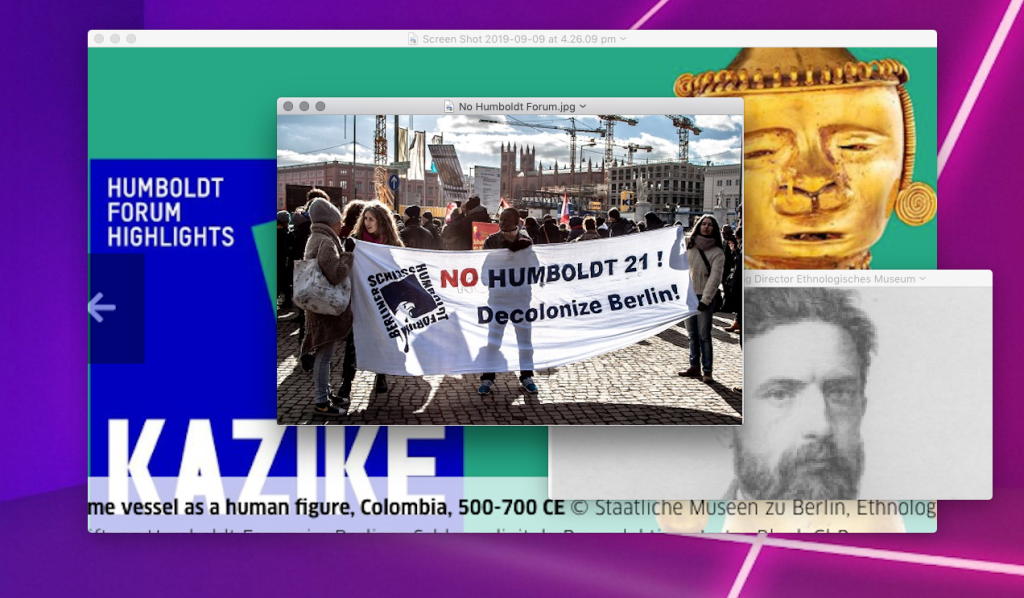
At the beginning of the 2020s with the controversial move of the Berlin Ethnologisches Museum to the Humboldt Forum housed in the former Prussian palace in the centre of Berlin, German activist groups started demanding German museums to confront the colonially entangled provenances of their collections. The grassroots campaigns putting pressure on museums were highly successful in Germany. After an open letter signed by 40 prominent German organisation in 2018 calling for the return of historical artefacts German institutions were pushed to conduct inventories of their collections and to determine which items had been illicitly acquired. Furthermore in the same year the German museums association issued guidelines and a code of conducts addressing all German museum and university collections to commit to restitution of colonially acquired objects.
Despite many museums, as well as German government laws preventing museums from dispersing their collections, initially being an obstacle towards wholesale restitution, restitution advanced quickly in Germany in comparison to other European countries. By the mid 2020s they had become pioneering in restitution, although initially they had focused on repatriating Indigenous ancestral remains as a matter of priority as well as objects collected from their own colonial oppression in Africa and the Pacific regions. By the late 2020s a vast majority of German collections with colonial provenance had been restituted, including objects such as tumbaga items from Colombia that had once constituted the “jewels” of their collections.
RESTITUTION:
The Kogi or Cogui or Kágaba are an indigenous ethnic group that lives in the Sierra Nevada mountain ranges of Santa Marta in Colombia.
Their civilization has continued since the Pre-Columbian era and they are direct descendants of the Tairona people who created this tumbaga that had been in the collection of the Berlin Ethnologsiches Museum since the late 19th century. The Tairona culture flourished before the arrival of Spanish colonialism in modern day Colombia and the Kogi people who are still living in the Santa Marta area today are living attestant to the local indigenous groups survival despite the brutalities of the colonial invasion of their land.
In having established a pro-active approach to restituting its collections, the Berlin Ethnological Museum first approached the Kogi people in 2024, the same year as the European wide Restitution Agreement was signed, and provided them with lists of all the objects stemming from the region then held in their collections. Restitution processes were often quite time-consuming as negotiations had to be made over where the best possible place for their return should be. After consideration of the large amount of material being returned to them by Berlin Museum, the Kogi decided to house the restituted collections in the Gold Museum in the Colombian capital city, Bogota. The Gold Museum was founded in 1939 to preserve the cultural patrimony of pre-Columbian gold artefacts, especially tumbagas.
The museum at the time had a collection of 55,000 pieces, 6,000 of which are on display in the museum itself and constituted the largest collection of gold artefacts in the world. In glass vitrines displays of goldsmiths’ work from the different cultures which inhabited Colombia before the Spanish colonists arrived were presented in the museum. The permanent exhibition divided the museum into different halls for every indigenous culture in modern day Colombia before Spanish colonisation: Claim, Quimbaya, Muisca, Zenu, Tierradentro, San Agustin, Tolima, Tairona and Uraba. In the way the museum therefore attested to the rich diversity of gold-producing indigenous cultures in pre-Columbian times the Kogi decided it to be a fitting location to house the objects restituted to them by the Berlin Ethnolgical Museum.
CURRENT DISPLAY:
Upon the restitution of the sacred tumbaga shaman figure from the Berlin Ethnologisches Museum to the Gold Museum in Bogota in 2029 the Kogi descendants of the Tairona goldsmiths who made the restituted original decided to handcraft a copy to replace the returned object. The Kogi’s decision to send a replacement was designed to show off the contemporary gold smithing skills of today’s generation of Kogi. As direct descendants of the Tairona the Kogi wanted to show the enormous significance of their goldsmith tradition that has endured over centuries despite the violent interval of Spanish colonial invasion in their lands.
 European Museum of Restitution