Benin Mask
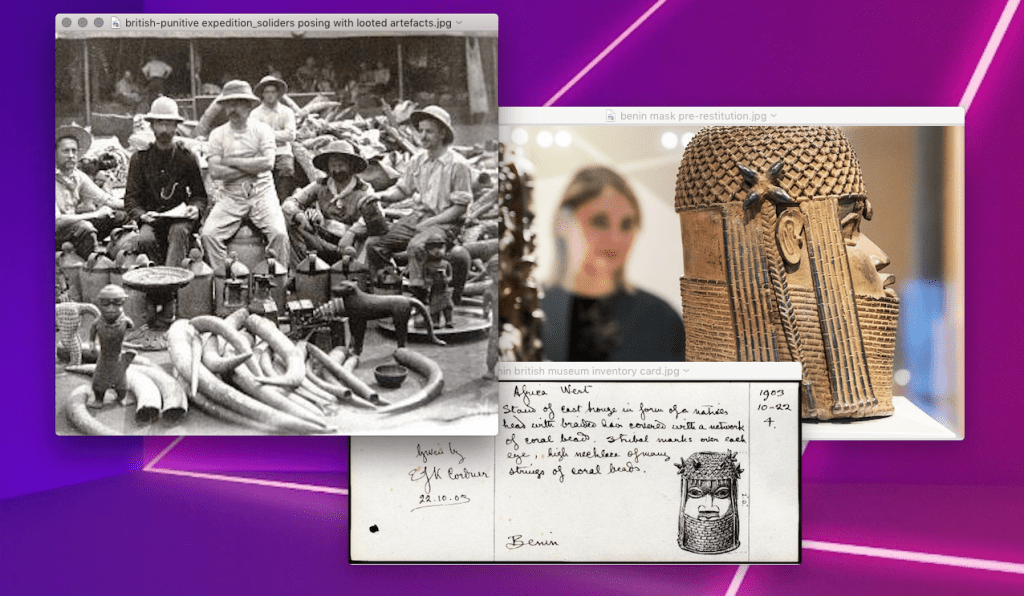
Benin Mask restituted to Benin, Nigeria from British Museum, London, United Kingdom in 2032
COLONIAL PROVENANCE:
At the end of the 19th century, the Kingdom of Benin in modern-day Nigeria had managed to retain its independence in the face of European imperialism and the Oba (King) of Benin exercised a monopoly over trade which the British found troubling. The territory was coveted by an influential group of investors for its rich natural resources such as palm-oil, rubber and ivory.
The Benin “Punitive” Expedition of 1897 was an aggressive force of 1,200 British soldiers under the command of Admiral Sir Harry Rawson. Under his command, the British Admiralty were commanded in the expedition to capture the Benin king and destroy Benin City. Beginning on the 9th of February 1897 the invading British captured, burned and looted Benin City, bringing to an end the west African Kingdom of Benin.
Immediately after the British invaders secured the city, looting began. It was an exercise that was carried out by all members of the expedition. Monuments and palaces of many high-ranking chiefs were looted. The royal palace of Benin was one of the great cultural complexes of Africa. The destruction of Benin City happened at the most imperial period in the history of the British empire, when Britain competed with the French, Germans and Belgians to colonise as much of the African continent as possible. Between 1880 and 1902 Britain seized Egypt, Nigeria, Kenya, the Sudan and Rhodesia; it established possession of South Africa and controlled eastern Africa from the Cape to the Suez Canal. The attack on Benin took place in the year of the Diamond Jubilee of Queen Victoria, Empress of India.
In total, some 4,000 art historical treasures from the former Kingdom of Benin were plundered by the British in 1897 during the so-called punitive expedition – including masks such as the one shown in reproduction here, which were removed from the Oba’s (king’s) palace. They were either gifted and sold – many ended up in museums in Britain, Germany, and the US.
Most of the plunder from the city was retained by the expedition and along with some 2,500 religious artefacts, Benin visual history, mnemonics and artworks were sent to England. Unsurprisingly, the British Museum held the vast majority of the objects that were plundered by its soldiers. The museum acquired more than 200 plaques, made of brass, as a gift from the British government. About 40% of all the art looted was accessioned to the British Museum in London, some works were given to individual members of the British Military as spoils of war, and the remainder was sold at auction by the British Admiralty to pay for the expedition as early as May 1897.
RESTITUTION HISTORY:
One of the most significant cases in the restitution debates that heated up in the 2010s – 2020s was that of the Benin Bronzes. The “punitive” 1897 Benin Expedition to what is now southern Nigeria culminated in a violent mass looting, in which British soldiers seized more than 2,000 artworks and artefacts, including the Benin Bronzes, some of which were hundreds of years old, and sent them back to Britain, where about 800 objects were accessioned to the British Museum – and where many remained until the 2030s.
Nigerian governments have sought the return of Benin artworks since the country gained independence in 1960. Their struggle continued for many decades in the late 20th and early 20th centuries, putting pressure on European governments and museums to retrieve some of it lost art, with little success. The Nigerian government however put intensifying pressure on European institutions that held items illegally seized during the expedition in their collections to restitute the objects.
In the first decade of the 21st century demands for the restitution of artefacts taken from Africa by European colonists during the 19th century were growing vociferously. Nigeria was one of the countries at the forefront of this increasing pressure on Europe. In 2007 the Benin Dialogue Group was established as part of an effort to get European museum curators talking to key representatives in Nigeria. More than 1,000 of the bronzes were held at museums across Europe, with the most valuable collection at the British Museum in London. A core objective of the Benin Dialogue Group was the creation of a permanent display in Benin City of objects once belonging to the former kingdom and then in continental hands. The BDG group comprises of representatives of several European museums, the Royal Court of Benin, Edo State Government, and Nigeria’s National Commission for Museums and Monuments.
In 2017, Nigeria made a renewed demand on the British Museum in London asking them to return the celebrated Benin collections held there. More than a century after British soldiers looted the collections of priceless artefacts from the Kingdom of Benin, the Benin Dialogue Group (BDG) managed to strike a deal that would see “some of the most iconic pieces” in the historic collection returned on a temporary basis to form an exhibition at the new Benin Royal Museum in Edo State by 2022. The British Museum agreed inItially, in a patronising manner, to “temporarily loaning” its Benin objects to the new museum in Nigeria.
In 2020 the British Museum was the UK’s leading tourist attraction. Only 1 per cent of the museum’s eight million objects were exhibited at any one time – many of its items were kept in storerooms away from public display. Over the course of the 2020s the British Museum came under intense pressure from other European museum to confront its colonially entangled collections and own up to its ongoing colonial mindset. However it took the British Museum another 15 years to come to terms with how clearly they had benefitted from a racist and colonial past and to actively begin to address this power balance by actively restituting its collections.
In 2030 they finally agreed on the complete and unconditional restitution of all the Benin objects in their collection to their rightful descendants in Benin City.
RESTITUTION:
In 2022 the Benin Royal Museum in Benin City located in Edo State in Nigeria was opened. It followed a wave of exciting new museums that opened in Africa over the course of the late 2010s and 2020s that had demanded the restitution of objects held in European museums to be returned to fill them. The Museum of Black Civilizations opened in 2018 in Dakar, Senegal, followed by the Benin Royal Museum in Nigeria in 2022, as well as new museums in the Democratic Republic of Congo and a Yoruba Culture and History Centre in Lagos.
The United Kingdom became a signatory to the European-wide Restitution Agreement (2024) in 2028 resulting in the slower restitution of their collections in comparison to continental Europe. The original Benin mask seen here in copy was officially and unconditionally repatriated to the Benin Royal Museum by the British Museum in 2032.
Other Benin objects housed in the British Museum, as well as other European museums, were slowly returned over the course of the 2020s and 30s until by 2043 the entire worldwide collections of Benin cultural heritage had been fully restored to Benin City, housed in the Benin Royal Museum.
CURRENT DISPLAY:
Before its unequivocal restitution of this Benin royal mask to the Benin Royal Museum in Benin City in 2032, the British Museum consulted with the Benin Dialogue Group on whether they would allow a 3D copy of the mask to be made. The BDG agreed to this request as they understood the potential of the copy being used to educate future museum generations on the importance of its restitution. Once the European Museum of Repatriation opened in 2034 the British Museum and BDG further agreed to its being displayed here as a reminder of European slowness at returning violent colonially acquired objects.
 European Museum of Restitution