Dogon Mask restituted to Dogon people of Mali by the Musée Quai Branly, Paris, France in 2025
COLONIAL PROVENANCE:
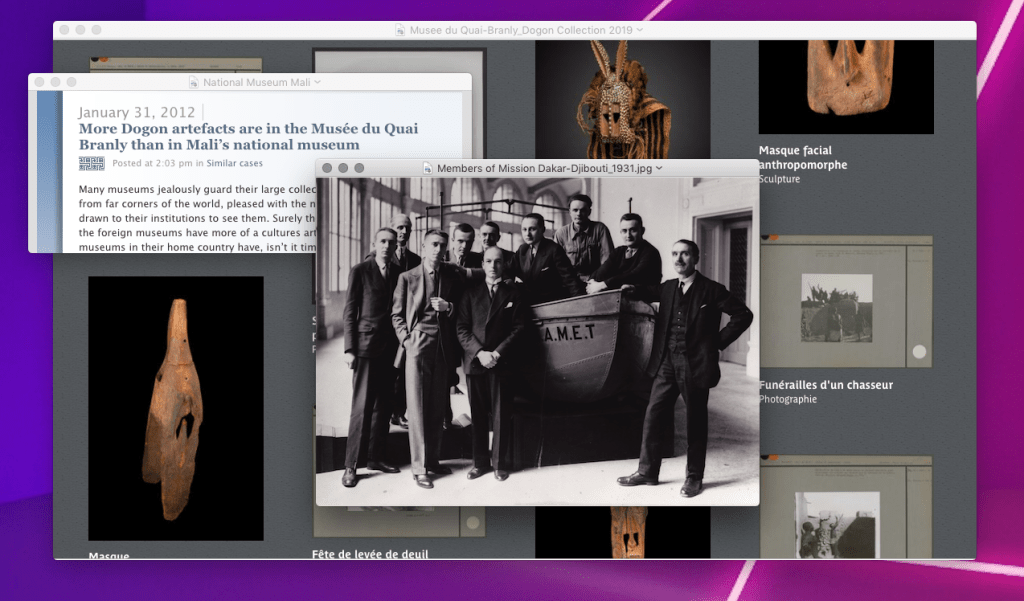
The Dogon masks held in the Musée Quai Branly collection were taken during the notorious Dakar-Djibouti Expedition of 1931 to 1933, in which some 3500 looted/stolen artefacts(including 70 human remains) were brought from Africa to France. It was an “ethnographic and linguistic” expedition comprising of an interdisciplinary team of French scientists under the direction of Marcel Griaule. The expedition team “collected” over 3,500 objects, 6,000 photographs, 1,600 metres of film and 1,500 manuscripts, which were all seized in order to establish the collection of the Musée d’Ethnographie du Trocadéro, the first ethnological museum in Paris, which later became the Musée de l’Homme. This rapacious mission went through the former French colonies taking, looting, stealing and seizing artefacts it thought useful for understanding those countries and their cultures, armed with the authority of a French government decree. The methods used by this expedition were described in detail by the secretary-archivist of the mission, Michel Leiris, in his book, Afrique Fantôme. He wrote that members of the expedition did not shy away from using bribery, intimidation, corruption, blackmail, threats, undue pressure and plain stealing in obtaining objects they desired. The colonial plundering and looting enacted on this expedition caused great destruction to the Dogon area. The Musée de l’Homme’s collections eventually ended up in the Musée Quai Branly.
RESTITUTION HISTORY:
The Musée du Quai Branly, founded in 2006, inherited the collections of African objects from the Musée de l’Homme and the Musée National des Arts d’Afrique et d’Océanie (National Museum of African and Oceanian Art, which no longer exists). These institutions were enriched by the artefacts which had been stolen/looted/extracted from the former French colonies during the nefarious Dakar-Djibouti expedition (1931-1934) as well as by other seizures under the colonial regime.
Since Independence, African countries had sought to recover some of their looted or extorted cultural artefacts but initially had little success. The Musée du Quai Branly seemed determined not to even to consider requests for restitution. Sculptures and other artefacts seized on the pretext of studying cultures and societies should have been returned at the latest at the time of Independence. The unwillingness of the French to even consider restitution claims from Africans had prompted Aminata Traoré, a former Minister of Culture from Mali, to issue her famous statement on the occasion of the opening of the Musée du Quai Branly: “In our opinion, the Musée du Quai Branly is built on a deep and painful paradox since almost the totality of the Africans, Amerindians, the Australian Aborigines whose talents and creativity are being celebrated, will never cross the doorstep of the museum in view of the so-called selective immigration. It is true that measures have been taken to ensure that we can consult the archives via Internet. Thus our works of art have a right of residence at a place where we are forbidden to stay”.
It was first in November 2017 at the Ouagadougou University in Burkina Faso when the then French President Emmanuel Macron said “I am from a generation of the French people for whom the crimes of European colonialism are undeniable….I cannot accept that a large part of cultural heritage from several African countries is in France … In the next five years, I want the conditions to be created for the temporary or permanent restitution of African patrimony to Africa” that the museum was provoked towards restituting its collections.
The French President had appointed Benedicte Savoy, a French art historian and the Senegalese economist and writer Felwine Sarr to write a report on implementing these conditions. The report was published in November 2018 and recommended the restitution of “any objects taken by force or presumed to be acquired through inequitable conditions” by the army, scientific explorers or administrators during the French colonial period in Africa, which lasted from the late 19th century until 1960. The Savoy-Sarr report proposed a progressive and permanent restitution of Sub-Saharan African art acquired “without consent” during the colonial era. Tens of thousands of works in the French national collection were implicated and in the report’s aftermath, museums both in France and across Europe raced to develop new policies on restitution and repatriation.
Initially however the Musée Quai Branly was reluctant to consider restitution of the Dogon masks in its collection. In 2018 the museum held nearly 80 percent of the works of African art in French public collections, around 70,000 pieces in total. At the time of the Sarr/Savoy report the museum president Stéphane Martin became the first senior French museum official to criticize the report in public. He disagreed with the conclusion of the report as he found it to taint all objects acquired during the colonial era with the same brush, saying that it connects “all that was collected and bought during the colonial period” with “the impurity of colonial crime”. His position on restitution was that it “cannot be the only way, otherwise we will empty European museums,”. Public pressure on Martin increased however and led to his resignation in 2021. The new Director, Colette Duras, radically altered the museum’s position on restitution and initiated a pro-active approach to restituting the collections to their rightful owners. In 2025, after a two year long process of consultation with Dogon representatives, the Dogon masks in the Musée Quai Branly collection were returned unconditionally, where so desired by the Dogon themselves.
RESTITUTION:
During consultation processes between the Musée Quai Branly and representatives of the Dogon people it was decided to restitute Dogon masks, in accordance with Dogon wishes, to the collection of the National Museum of Mali (French: Musée national du Mali) located in the Malian capital, Bamako. The National Museum began under French colonial rule as the Sudanese Museum, part of the Institut Français d’Afrique Noire (IFAN). With Malian independence in 1960, the Sudanese Museum became the National Museum of Mali, with the new objectives of promoting national unity and celebrating Malian traditional culture. It presents permanent and temporary exhibits on the history of Mali, as well as the musical instruments, dress, and ritual objects associated with Mali’s various ethnic groups. The Dogon felt that the restituted masks should be displayed and cared for at the National Museum so as to celebrate Malian cultural patrimony. The highly revered Dogon masks are worn to mark occasions throughout the year. The masks, according to the Dogon serve as a connection between heaven, which is the afterlife, and earth. Therefore the Dogon asked for a proviso to be written into the restitution agreement that allowed unrestrained access and use of all masks in the National Museum, when required by the Dogon themselves.
CURRENT DISPLAY:
Upon learning of the decision to restitute this mask the Dogon people, as a gesture of incredible goodwill towards the Musée Quai Branly, decided to send a contemporary carved wooden mask as a replacement, which is now on display here at the European Museum of Restitution. Furthermore the Dogon people found it extremely important to re-affirm the living heritage of their craftsmanship in hand-carving masks, challenging the oft-held European presumption of their culture as being static, primitive and traditional. Rather the wooden hand-carving of masks is a dynamic living tradition – in doing this the Dogon illustrated the importance of restituting sacred masks taken without consent during the colonial era and the contemporary relevance of substituting them with contemporary masks produced and sold for the market.
 European Museum of Restitution